NOEL SICKLES...
..The Great Journeyman

One of the sadder aspects of the relentless ascendance of digital life, of the replacement of flesh and blood society with social media, is the swarm of obituaries that frequently follow the death of an actor, whether stellar or journeyman, on the various digital platforms that now serve as public squares.
All too often the requiem pays no attention whatsoever to a career of any length or consequence, and eulogizes this performer as “…Best remembered for his role in whatever SUPERMONSTERDRAGONROBOTDEMONLASERSPACEMUTANT…” bloat this increasingly gleefully incurious, willfully ignorant, and historically amnesiac audience knows him from, mistaking what anyone with just a little bit of sense recognizes as no more than a pay check, and maybe even potentially serious fuck you money, for chosen work.
As if such a choice actually existed.
For reasons which I hope I’ll be able to explain, this made me think of Noel Sickles.
I met Noel Sickles only once, and then only briefly, in a short conversation shared with a detached and distant Milton Caniff at a San Diego comic book convention, before it became a moshpit geek watching tourist attraction.
I bullshitted my way into their acquaintance by mentioning—overstating, to be honest—my “relationship” with Alfred Andriola. I had been in a class with him some fifteen years earlier, but that detail didn’t come up.
Andriola had been their Tudor City studio assistant back in the day, and my questions for them were, simply, “How do you delegate to an assistant—and how much?” Their answers were vague polite and unhelpful, but hey—Milton Caniff and Noel Sickles!
I didn’t mention to them the rumor that they had had a big hand in tweaking Andriola’s samples for his first syndicated feature, CHARLIE CHAN.
But I digress.
It bears mentioning, and firmly, that, nearly fifty years ago, if a man of my generation or after knew the name Noel Sickles, it was an inside baseball awareness, a size twelve footnote, to the saga and career arc of Milton Caniff.
We knew that it was Sickles who had clipped out the velox photographs from the NEW YORK DAILY NEWS and THE DAILY MIRROR, and with india ink and white tempera reduced the grainy photos into chiarascuros—then applied this technique of elimination to his own work.
Caniff, who begins TERRY AND THE PIRATES in a style familiar to anyone who’d read DICKIE DARE, his previous strip, soon absorbed this technique of Sickles’ and used it to create the greatest adventure comic strip in the history of the medium.
Meanwhile, Sickles took over the dreadful SCORCHY SMITH, and after aping the crudities of talent free Paul Terry, subtly brought this minor comic strip, one of many inspired by the country’s obsession with aviation in general and Charles Lindbergh in particular—TAILSPIN TOMMY, SMILIN’ JACK, FLYIN’ JENNY, to name a few—up to a visual par that was competitive on that level with Caniff.
Unfortunately, the writing on SCORCHY SMITH ran the gamut from dull to dreadful, whereas Caniff, on TERRY, found his metier as a great cartoonist, an artist who equaled himself as a writer. He spent twelve years on TERRY, then spent the rest of his life on STEVE CANYON.
Imagine if Caniff had been as helpful to Sickles at the typewriter as Sickles had been with his brush.
Sickles, on the other hand, had other ambitions beyond the comics page in mind. He left Scorchy Smith after three years, and took his chiaroscuro technigue, with the addition of tonal pencil, and became a very effective illustrator of wartime events, based on descriptions from those who were there, for LIFE MAGAZINE.
LIFE was a magazine devoted to the newly minted idea of photojournalism. The actual photographic record of the war as it was fought was censored by the War Department. Sickles work made clear for the home front audience what was happening to their fathers, brothers and sons overseas; minus the actual blood and horror.
Read WARTIME by Paul Fussell to get a sense of how this censorship played out.
This was the beginning of a long career, a career without the public awareness awarded to his studio mate, with whom he collaborated on a series of comic strip ads for JOHNSTONE AND CUSHING, and advertising agency that used comics for magazine ads, for a product called POSTUM—a coffee substitute aimed at the caffeine sensitive.
The strips were pseudonymous, signed PAUL ARTHUR, Caniff’s middle names. I’d love to know why this choice was made.
Now, it must be noted, certainly for those much younger than I, that in this time, comic strips and their creators were well known, well paid, and well regarded public figures. The celebrated of their day—actors, writers, politicians, et al—all read the comics. Not comic books, of course. They were just shit for kids and the slow minded. but newspaper strips were for everyone.
When Capp finally married Abner to Daisy Mae, it made the cover of LIFE. When Caniff killed off a major character in TERRY, the lobby of the New York Daily News was crowded with funeral wreathes, and the mailroom overflowed with letters of condolence. When Caniff left TERRY to create STEVE CANYON, he made the cover of TIME MAGAZINE, for fuck’s sake.
Imagine that.
But illustrators, except for the very top tier, and I mean top, were mostly anonymous—this, in a time when, to a profound extent, even the most average magazine, editorial and advertising artist’s skillsets were, to put it mildly, phenomenal. The bottom was good. The middle was great. The top was populated by geniuses.
This is the world that Noel Sickles navigated for the entirety of his career once he ceased to be a comic strip man in 1936…a world of at the very most, minimal awareness, let alone interest, to comics enthusiasts. He functionally vanishes from the comics enthusiast’s story, except as a cognoscenti’s acknowledgment in a discussion of Caniff or Sickles’ most fervent acolyte, Alex Toth.
Sickles becomes as archetypal a journeyman illustrator as can be imagined. He expands his skillset, learning to paint, and his draughtsmanship, already pretty damned fine, improves steadily. There was a lot of work out there, in a culture wherein print media was king…but, as noted, the competition was fierce.
And, as the 1940s threatened to become the 1950s, there was a sudden burst of creative energy, lining up with a magical five years after V-E and V-J days, between 1945 and 1950, when the United States was a planet of its own, and New York City, untouched by the ravages of war that had shattered Europe, was on creative fire. Music, film, dance, theater, illustration—it was, in every way, a new golden age.
Read Jan Morris’ brilliant MANHATTAN 45 to get a whiff of what those years must have been like.
Now, the most famous illustrator working in the United States, from the 1930s to his death in 1978, was Norman Rockwell. Everybody knew his name, his work. Rockwell was brilliant, skilled enough to suffer and survive a world that, as those forties became the fifties, snidely resisted his sentimentality with skepticism bordering on cynicism.
There’s a damned good reason why, when that sly dog Albert Dorne figured out a potential con job he first abortively called THE INSTITUTE OF COMMERCIAL ART, INC., and finally went public with THE FAMOUS ARTIST’S SCHOOL, he used Norman Rockwell in his “We’re looking for people who like to draw” advertisements.
(Dorne used himself, too. Again, I wonder what the thinking was behind that.)
When Dorne and Rockwell put their marquee name faculty together, there were a few givens—the two of them, of course—and Al Parker, Robert Fawcett, Jon Whitcomb, Austin Briggs, Harold Von Schmidt and Stevan Dohanos.
The rest came on board, with one spot open, for which Noel Sickles was the likely final add.
Then, Sickles was rejected, because, the story is told, he bore too much in common with Robert Fawcett. I wonder whether by Fawcett himself; he was apparently not the kindest nor most generous of men—or by mutual agreement.
I don’t get this at all. To my eyes, Fawcett, brilliant as he was—he remains one of my five favorite illustrators; I own four originals—had a very specific range and attack. Sickles worked in far more media, with far more experimental approaches and techniques, than Fawcett, who, other than his late career experiments with FLO-MASTER markers, stayed in his own neighborhood.
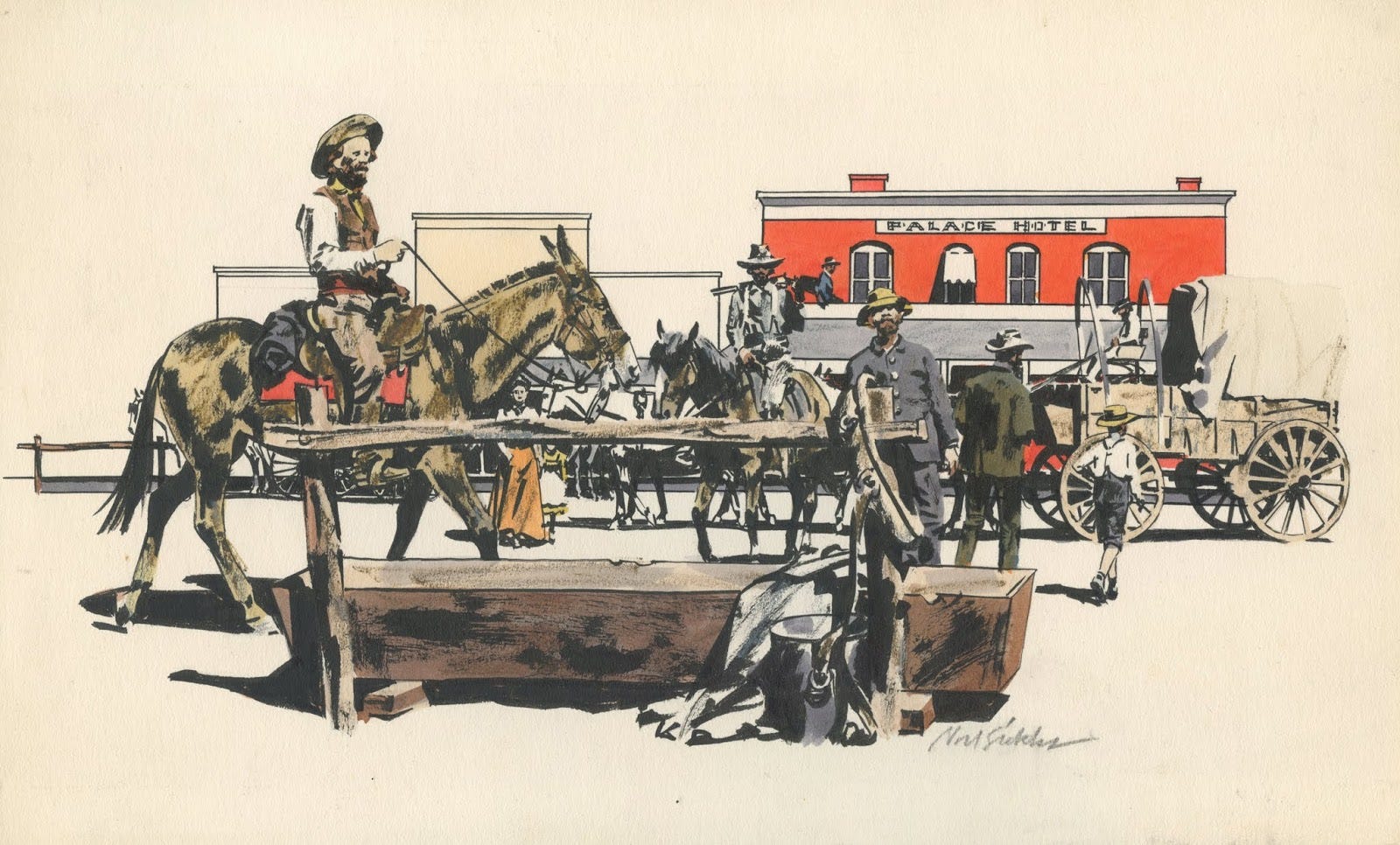
I wonder if this caused Sickles some damage, if not professionally per se, but in terms of self, of ego. He continued to work, doing a great deal of advertising, editorial and book illustration. His work for THE READER’S DIGEST CONDENSED BOOKS, which published abridged versions of popular novels, and thus depended on illustration to clarify and support narrative, is shockingly good in its bravura technique, its modernity, its audacity, its courage of experimentation.
Long before I met him that brief time, I was hired for my second art job by a studio called THE ROSSEN CREATIVE GROUP, which packaged comp art for advertising agencies. I was the Art Boy, office runner, deliveries, all scut all day. It was 1969, I was eighteen, barely half the age of the youngest professional freelancers coming and going all day.
All these artists were men, who had been in that bottom and middle tier only a few years earlier. The work for artists with strong drawing skills was vanishing at an astonishing pace, and talent who had once filled magazine pages were now doing comps for J.Walter Thompson, Ogilvy-Mather, Benton & Bowles, and the rest.
The only name I remember from those days is Mac Conner, a very talented middling artist who would ultimately live a very long life, achieving enormous acclaim, mostly, to be sure, for being the last man standing.
On the basis of what I heard a few years later, I would not be at all surprised if Sickles had passed through this place at one time or another.
In the 1970s, I did a few years of day work at agencies, most often JWT, doing what were called teeny frames, rough ad boards for sales meetings between account executives. The money, $150 a day, was fantastic for that time, and kept me afloat.
When one of the staffers found out I was a comics guy, he asked me whether I’d ever heard of a comic strip artist named Noel Sickles. I acknowledged that I had, and admired the work. Several years later in the course of a conversation with a giant of late twentieth century illustration, who had worked at JWT as a board man back then,I mentioned this.
He apparently had shared a cubicle with Sickles. To my shock, he dismissed Sickles as a pale imitation of Robert Fawcett. What followed was a spirited argument, which I lost. This fellow was a very big deal.
All this notwithstanding, beyond the reductive nature of comics forgetting anyone who moves on, as noted above, I believe that Sickles’ reputation was sullied by the very fact that he did so many different things so well. Mitchell Hooks is another artist deserving of a larger footprint who falls into this same category of too many skillsets and approaches to be labeled and categorized.
And finally, if we return to those thrilling days of yesteryear, the mid 1930s, and take a hard look at those two comic strips, we must agree that if his colleague Caniff was the Rembrandt of the comic strip, then Sickles, for just those three short years, was comics’ Caravaggio…and would become so much more.